

Why Direct Booking Vacation Rentals Are Better (and How to Find Them)

There is a version of this argument that begins with fees — the percentage extracted by the major platforms, the checkout totals that bear little resemblance to the price that first caught your attention — and stops there. It is a compelling version, and the numbers make their case on their own terms.
More travelers are now searching for direct booking vacation rentals — homes that can be reserved directly with their owners rather than through large booking platforms.
But the fuller case for direct booking is not primarily financial. It is about the quality of a relationship, and what that relationship produces.
When a guest books directly with a homeowner, something shifts. The transaction becomes a conversation. The home becomes, however briefly, something offered rather than sold. The stay that follows carries a different quality — more anticipated, more personal, more fully itself — than one mediated through an algorithm’s best guess at what you might want.
This is better for guests. It is also, in ways that are equally important to understand, better for the homeowners who offer these properties. And it is better, ultimately, for the places these homes occupy.
Better for Guests: Beyond the Fee Question
The financial case is real and worth stating clearly. Platform service fees — typically 14–16% on Airbnb, 6–15% on VRBO — add materially to the cost of every booking, and that addition flows not to the homeowner but to the intermediary. On a significant stay, the difference runs to hundreds of dollars.
But the non-financial advantages are the ones that compound across the experience of the stay itself. A homeowner who manages their own bookings responds to enquiries personally. Their knowledge of the property — the bedroom that catches the morning light, the trail that begins five minutes from the back gate, the restaurant in the next village that has been quietly excellent for years — arrives through genuine conversation rather than auto-populated welcome notes.
The listing description itself changes. Owners writing for their own platform describe their homes with specificity and honesty: the particular character of the kitchen in afternoon light, the view from the upstairs window that the photographs do not quite capture, the quirk of the heating system that is worth knowing about before arrival. This is different in kind from copy optimized to convert against a platform algorithm, and it is a more reliable guide to what you will actually find.
Better for Homeowners: The Relationship They Actually Want
The platforms that transformed vacation rentals over the past decade created something genuinely useful — and then extracted an increasingly significant price for access to it. For homeowners, the economics have shifted to a point where a meaningful percentage of every booking funds a marketplace they have no control over, in exchange for discovery by guests they might not have chosen.
Direct booking restores the relationship that most homeowners were seeking when they first decided to share their home. They can choose their guests through genuine conversation rather than accepting whoever the algorithm delivers. They can set their own terms, communicate their expectations honestly, and invest in the kind of pre-arrival preparation — the welcome note, the local recommendations, the arrangement for a slightly later departure — that makes the stay memorable for both parties.
The financial dimension matters here too. On a $3,000 booking, a 3% host platform fee represents $90 that goes to the marketplace rather than to the maintenance, improvement, or simple enjoyment of the home. Across a season, those sums accumulate into a meaningful argument for a different approach.
Better for the Home Itself
There is a third beneficiary in the direct booking relationship that is easy to overlook: the home.
Homes offered through the major platforms are subject to the platform’s incentive structure — which rewards volume, competitive pricing, and review scores rather than the care and character of the property itself. A homeowner under platform pressure to fill calendar gaps and maintain a five-star rating is a homeowner whose decisions are being made, at least partially, by a system that has no interest in the home as anything other than inventory.
Direct booking allows homeowners to manage their properties on their own terms. To accept fewer but better-suited guests. To close the calendar during periods when maintenance or rest is more important than revenue. To invest in the quality of the experience — a new set of linens, an improved welcome arrangement, a thoughtful addition to the library — because the relationship with guests makes that investment feel worthwhile rather than compulsory.
This is why homes are not inventory — they are stories. And direct booking is the arrangement that allows them to be offered that way.
Better for the Places These Homes Occupy
The broader effects of vacation rental on the communities that host it have been well documented and are genuinely complex. The platforms, by making short-term rental accessible at scale, have contributed to housing pressures in desirable destinations, homogenized the experience of travel, and in some cases eroded the local character that made those destinations worth visiting in the first place.
Direct booking is not a solution to these larger structural questions. But it represents a different relationship to place — one where homeowners are typically longer-term community members, where guests tend to arrive with more genuine engagement with the destination, and where the transaction is embedded in local context rather than abstracted into a global marketplace.
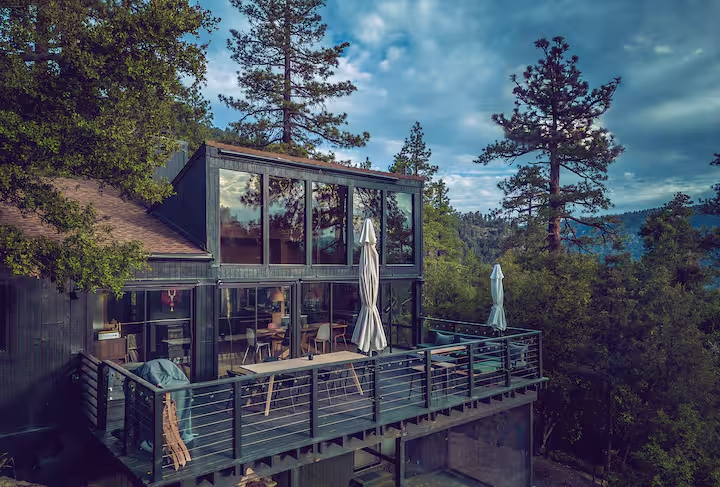
The Hamptons homeowner who books guests directly and recommends the local fishmonger, the Catskills cabin owner who has maintained the trail behind the property for thirty years — these are not platform-optimized hosts. They are people with a genuine stake in their landscape and a genuine interest in introducing it to guests who will appreciate it.
Many of these homes can now be discovered through curated direct-booking platforms like Locèlle, where guests connect directly with the owners who know their homes best:
How to Find Direct Booking Vacation Rentals
Finding direct booking vacation rentals has become easier as curated platforms now connect travelers directly with homeowners.
One of these platforms is Locèlle, which presents a curated collection of design-led homes where guests can book directly with owners without platform service fees.
Locèlle operates across destinations including the Catskills, the Hamptons, coastal New England, and other thoughtfully chosen locations where architecture, landscape, and hospitality come together.
Browse the full collection of homes here:
https://www.locellestays.com/listings
Each property is presented by its owner with honest descriptions, transparent pricing, and the kind of local knowledge that only comes from a genuine direct conversation.
The argument, ultimately, is not complicated. Direct booking produces better stays, better relationships, and a better use of the homes themselves. The fee question is where most people start. The quality of what follows is why they do not go back.
Frequently Asked Questions
What does direct booking a vacation rental mean?
Direct booking means reserving a vacation rental directly with the homeowner rather than through a large booking platform.
This can happen through an owner’s own website, through curated direct-booking platforms like Locèlle (https://www.locellestays.com), or through a direct introduction. Because there is no intermediary platform collecting a percentage of the transaction, the relationship is between guest and owner from the first message.
Is direct booking always cheaper than Airbnb?
Direct booking typically eliminates the platform service fee — usually around 14–16% on Airbnb. The nightly rate and any costs set by the homeowner still apply, but the platform’s additional percentage does not. On longer stays, this difference can amount to hundreds of dollars.
Why do some homeowners prefer direct bookings?
Many homeowners prefer direct bookings because the relationship with guests becomes more personal. Communication is clearer, expectations are aligned, and there is no platform commission reducing the owner’s payout. It also allows homeowners to manage their properties according to their own standards rather than optimizing for marketplace algorithms.
How do I find vacation rentals that accept direct bookings?
Platforms like Locèlle curate vacation homes that can be booked directly with their owners. These homes are typically design-led, independently managed properties where guests connect directly with the people who created and care for the space.
Explore the collection here:
https://www.locellestays.com/listings




Discover homes worth traveling for
Join the Locèlle newsletter for design-led stays and off-market finds
Get on the list
Discover homes worth traveling for
Join the Locèlle newsletter for design-led stays and off-market finds
Get on the list